Restaurant insurance in Germany for Indian restaurant owners
Understand what protects your guests, your kitchen and your income. A practical guide to liability, business contents and interruption cover, including tandoor ovens and your responsibilities towards the landlord.
You may rent your premises, own some of the equipment and lease the rest. You may serve guests, deliver food and cater for weddings. One policy name does not tell you whether all these activities are covered.
This guide explains the main types of cover in plain English. German terms appear alongside them so you can recognise them in your insurance documents.
Editorial research updated: 2 October 2026. General guidance for restaurants operating in Germany. Cover depends on the insured business, selected sections, limits, exclusions and policy conditions. Examples illustrate possible claims, not guaranteed payments.
1. Start with three different types of protection
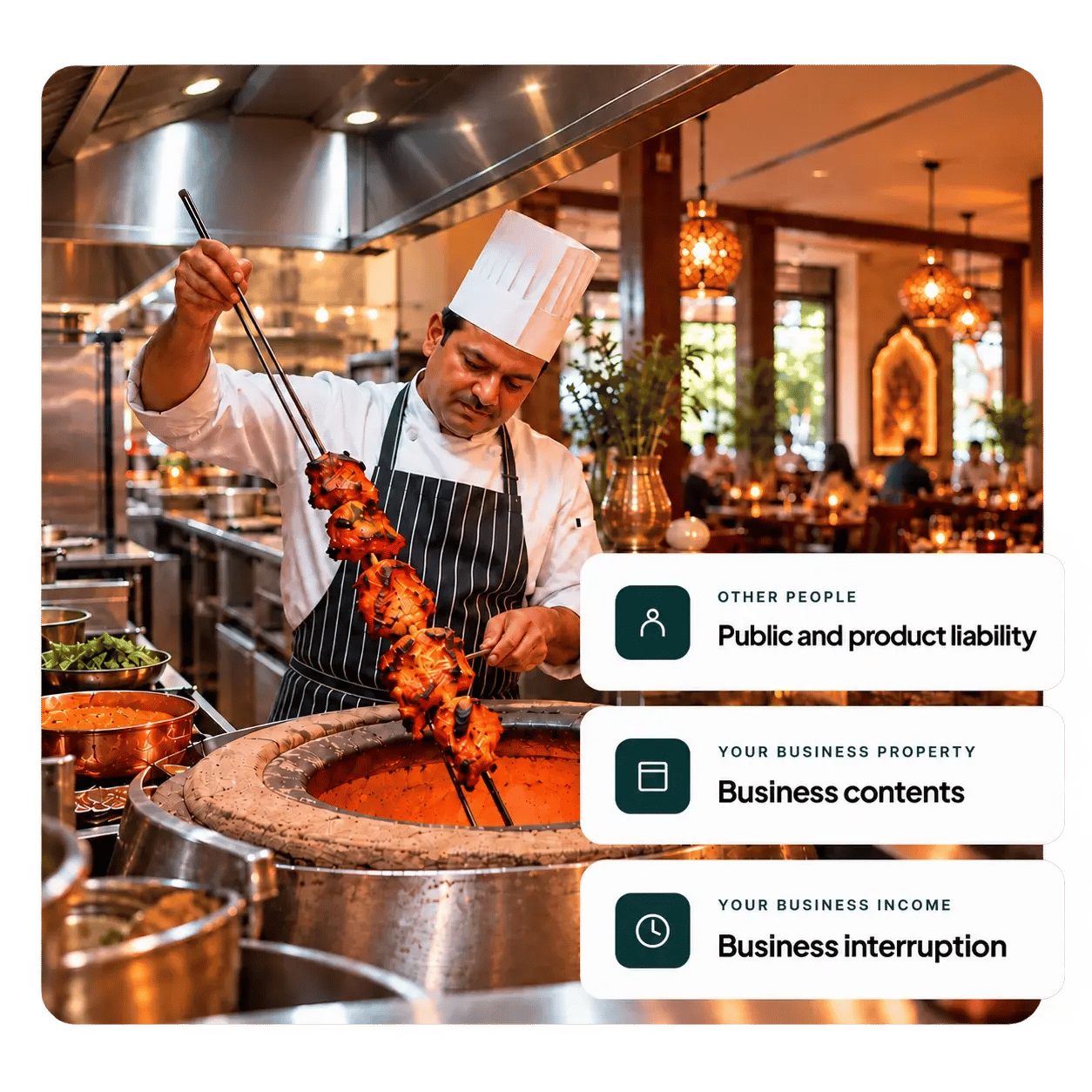
OTHER PEOPLE
Public and product liability
Betriebshaftpflicht, including appropriate product liability cover.
Handles covered compensation claims when your business injures someone or damages their property. It also defends you against unjustified claims.
YOUR BUSINESS PROPERTY
Business contents
Inhaltsversicherung
Protects insured equipment, furnishings and stock against agreed events such as fire or burglary. It does not automatically cover every breakdown.
YOUR BUSINESS INCOME
Business interruption
Betriebsunterbrechung / Ertragsausfall
Can cover continuing costs and lost operating profit following an insured interruption. The trigger and payment period matter.
These sections may be sold together, but they perform different jobs. Check each one in the quotation and policy schedule. [1][2][3]
2. One kitchen fire can create several different claims
Imagine a fire starts in your kitchen. Your equipment is destroyed, smoke damages the landlord’s building, a guest is injured and the restaurant cannot reopen for several months.
ILLUSTRATIVE SCENARIO
One fire. Four questions.
Your kitchen
What has been affected?
Your own ovens, furniture and food stock
Cover to check
Business contents with fire cover
Important condition
The property and its correct value must be insured.
The rented building
What has been affected?
The landlord’s walls, ceilings and other building parts
Cover to check
Liability for damage to rented premises
Important condition
You must be legally liable and the claim must fall within the policy.
An injured guest
What has been affected?
An injured guest
Cover to check
Public liability
Important condition
Liability and the circumstances of the injury are assessed.
Your running costs
What has been affected?
Your continuing costs and lost operating profit
Cover to check
Business interruption
Important condition
The insured trigger, financial limit and indemnity period apply.
3. Protect your business when someone claims compensation
A guest slips on a wet floor. A waiter spills hot chai. A customer says a meal caused an illness. These situations can lead to claims for injury, damaged belongings and resulting financial losses.
Liability insurance examines whether the claim is justified. It pays covered claims for which you are liable and defends you against unjustified claims. A complaint or allegation alone does not establish liability. This defence is not the same as general legal expenses insurance for every business dispute. [1]
Food, ingredients and allergies
Ask for the production, preparation and sale of your meals and drinks to be included in the business description. The review should cover food eaten in the restaurant, takeaway meals and food supplied through delivery or catering.
For example, a sauce may contain cashews, a marinade may contain milk, or a bought-in spice mix may include an ingredient that staff overlook. Check how the policy treats claims arising from incorrect ingredient information and cross-contact with allergens. Do not assume every product liability extension is designed for the same activity.
Insurance does not replace food safety procedures, accurate allergen information or staff training. Keep ingredient records, review supplier changes and make sure staff can give reliable information. The IHK explains the separate obligations relating to food hygiene and allergen information. [6][7]
Look beyond the headline limit
Compare the maximum payment per claim, the total available per insurance year, the excess and any lower limits for particular risks. Several people affected by the same batch of food may be treated as one event under the policy’s series-of-claims wording.
As a practical comparison starting point, consider quotations with a €10 million combined limit for bodily injury and property damage. This is a recommendation for discussion, not a legal minimum or a guarantee of sufficient cover for every restaurant. A lower limit for rented premises can still leave a significant gap.
Also ask about employees acting for the business, temporary helpers, loss of the landlord’s keys and customers’ belongings in your custody. Check the wording rather than assuming that every member of staff or every borrowed item is automatically covered. [4][7]
4. Understand your responsibility towards the landlord
Renting a restaurant does not make you automatically responsible for every defect or every fire. Liability depends on what happened, the applicable law and the rental agreement. Ordinary deterioration through agreed use is treated differently from damage for which you are responsible. [8]
OWNED BY YOU
Your equipment and stock
Review contents cover and realistic replacement values.
OWNED BY SOMEONE ELSE
Premises and leased equipment
Check your liability and who is responsible for insuring each item.
Damage to rented premises
Look for Mietsachschäden: damage to rented property. Ask specifically about fire and explosion damage to rented rooms and buildings, smoke-related damage and any resulting financial claims, such as the landlord’s loss of rent. Their inclusion, limits and exclusions need to be checked.
A rented building is not the same as a rented kitchen
A policy covering damage to rented rooms may have different rules for leased ovens, a rented dishwasher or a complete kitchen included in the lease. Make a list of who owns each major item and who has agreed to insure it.
For equipment belonging to someone else, check both property cover and liability cover. These answer different questions: whether the item is insured against an event, and whether you are insured against the owner’s claim for damage you must compensate. [4]
Do not rely only on the landlord’s building insurance
If the building insurer pays a loss, an existing claim against a responsible third party can pass to that insurer. Whether it can recover money from you depends on the circumstances and any applicable restrictions. The landlord’s policy therefore does not replace your own liability review. [5]
5. Does a tandoor oven affect your insurance?
It can matter, but the word “tandoor” alone does not determine the premium or the cover. The insurer needs to understand the appliance, fuel, installation and operation. An electric oven and an indoor charcoal-fired oven should not be described as if they were identical.
Electric
Gas
Charcoal
Tell your adviser:
Whether the oven uses electricity, gas, charcoal or another fuel.
Whether it is fixed or portable, indoors or outdoors, and who owns it.
How it was installed and what inspection or maintenance documents exist.
How extraction, cleaning, fuel storage and hot ash disposal are managed.
Whether it is also used for catering or events away from the restaurant.
For indoor charcoal cooking, the BGN describes specific precautions for combustion gases, ventilation, inspection and safe ash disposal. This is a reason to check the actual installation, not to claim that all tandoors are excluded or always cost more to insure. [9]
Our practical recommendation is to have the appliance and fuel type recorded in the risk information and obtain written confirmation that the insurer has accepted the described operation. Tell the insurer before introducing materially different equipment or changing fuel type.
Kitchen safety remains part of the picture
Keep inspection and cleaning records. Follow applicable fire precautions and the insurer’s agreed safety requirements. For fryers, the BGN highlights supervision, suitable class F extinguishers and regular cleaning of extraction equipment. [10]
6. Insure your equipment and stock at realistic values
Business contents can include kitchen equipment, furniture, tills, computers, utensils and food or drink stock. Check tenant-installed fittings, leased equipment and property at other locations separately.
The important question is: What would it cost to replace the insured contents with equivalent new items today? The price you paid for a used kitchen or the remaining value in your accounts may be much lower.
Prepare an inventory, retain invoices and photographs, and update values after major purchases. Include peak stock levels before weddings or festivals. Check whether VAT belongs in the insured value for your business and whether installation, delivery and other necessary costs are accounted for.
Check the insured causes of damage
Cover
Question to ask
Fire
Are the contents and relevant clean-up costs covered following a kitchen fire?
Escape of water
Which pipes, installations and resulting damage are included?
Burglary and related vandalism
What counts as burglary and which security measures are required?
Storm and hail
Does cover extend to the relevant outdoor equipment?
Natural hazards
Are flooding from heavy rain and sewer backflow included, and on what terms?
Additional expenses
What limits apply to debris removal, disposal, cleaning and additional replacement costs?
Water from a burst pipe and water from a flooded street are not interchangeable insurance events. Likewise, burglary and simple theft may receive different treatment. Choose the required sections rather than relying on the general name “contents insurance”. [2][11]
Underinsurance can affect partial losses
Unterversicherung means that the sum insured is too low compared with the relevant insurance value. Under some policies this can reduce a payment even when only part of the contents is damaged.
Ask whether there is an underinsurance waiver, what conditions it requires and what limits apply. Also check the conditions for replacement at new value. [11]
Gross negligence and contractual duties
“Gross negligence included” is not a complete explanation. Ask about the maximum amount covered and distinguish causing a loss through gross negligence from breaching a policy duty, such as an agreed safety requirement. Insurers may treat them differently. [11]
A fridge can stop working without a fire, burglary or burst pipe. The food may spoil, the appliance may need repair and the restaurant may lose trade. Those are three different losses.
Spoiled stock: Does cover include chilled and frozen food, a technical failure and an external power outage?
The appliance: Does the policy cover the actual fault, or is machinery cover needed?
Lost income: Does the interruption section respond to that particular event?
Check the maximum value of stock, any minimum outage duration, temperature requirements and the excess. A useful question is whether the limit would cover your busiest week, not just an average Tuesday.
Published insurer examples show why this needs care: some descriptions distinguish refrigerator contents from frozen goods, while others specify particular causes of refrigeration loss. Never treat “food in fridges covered” as proof that every type of spoilage is insured. [12][13]
Other details worth checking
Review glass breakage, signage, cash storage limits, outdoor furniture and equipment transported to events. A patio chair stolen without a break-in may need a different extension from burglary inside the restaurant. Technical breakdown, wear and poor maintenance are not automatically covered just because an item appears in your inventory. [14][13]
8. How will you pay the bills while you cannot open?
Replacing an oven does not pay wages during a lengthy closure. Business interruption insurance can protect continuing insured costs and lost operating profit following an insured event. It does not simply reimburse all lost sales regardless of saved expenses.
Review the insured financial basis, covered causes, excess or waiting period and the Haftzeit, the maximum indemnity period. Consider realistic rebuilding time, approvals, specialist equipment delivery and the time required to resume trading. [3]
As a planning exercise, compare 12 and 24 months rather than choosing the shortest period automatically. That is a recommendation for discussion, not a universal requirement. Ask how partial trading through takeaway or a temporary kitchen affects the claim and whether necessary extra expenses are insured.
Business closure insurance is a separate question
Betriebsschließungsversicherung may cover specified official measures connected with insured diseases or pathogens. It is not a promise to pay whenever an authority closes the restaurant.
The named diseases, connection to the insured premises, type of official order, payment period and exclusions matter. For example, the GDV model wording restricts cover to specified circumstances and excludes epidemics and pandemics. Actual insurer wording must be reviewed. [15]
9. Include delivery, catering and festival work
Your policy should describe the business you actually run. Use the following prompts when applying or renewing:
Do you offer takeaway or use delivery platforms?
Do your own staff deliver, and which vehicles are used?
Do you provide catering for weddings, offices or private parties?
Do you operate stalls at Diwali celebrations or other events?
Do you use another kitchen, store stock elsewhere or trade from several locations?
Do you sell packaged products under your own brand or import food directly from outside the EU?
Ask separately about motor insurance for delivery vehicles, cover for goods in transit and equipment away from the premises. Do not assume a platform’s insurance protects every part of your business. Direct imports and own-brand products can require a closer product liability review. [16]
Update the description when you expand. A restaurant that starts operating a mobile catering business should check cover before the first event.
10. Before you buy or renew
Use these questions to compare quotations. A low annual premium is useful only if the cover matches your operation.
Tick each topic once you have discussed it. This is a preparation checklist, not a coverage assessment.
Documents to prepare
Collect your current policy and schedule, rental or lease agreement, equipment list, approximate replacement values, turnover information, details of staff and activities, recent claims history and any relevant installation or inspection records. Missing details can be clarified during the review.
11. What to do after a loss
Protect people first and call the emergency services where necessary.
Take reasonable steps to prevent further damage when it is safe to do so.
Notify the insurer or adviser promptly. Inform the landlord if the premises are affected.
Record the damage with photographs and keep invoices, stock records and details of the event.
Coordinate repairs and disposal with the insurer where practicable. Do not delay urgent safety or hygiene measures; document them.
Forward compensation demands promptly. Avoid promising payment or settling a claim before the insurer has assessed it.
Follow the reporting and evidence requirements in your own contract. For food spoilage, record quantities, temperatures and the suspected cause where possible without creating a health risk.
12. Frequently asked questions
Do not assume your personal policy covers running a restaurant. Commercial activities need to be assessed and insured appropriately. Any limited private-policy extension must be checked against the actual business.
Not automatically. The building policy and ownership of the equipment must be checked. Your own contents, leased equipment and the landlord’s fixtures may have different arrangements.
No. Liability depends on the cause, circumstances and applicable duties. A suitable liability insurer assesses claims, defends unjustified demands and pays covered claims for which you are liable.
No general exclusion can be inferred from the name of the oven. Disclose the appliance, fuel and operation, and obtain confirmation of the insurer’s acceptance and any requirements.
Not necessarily. Repair of the fridge, spoiled food and lost income are separate questions. Check the covered cause for each loss.
That depends on valuation and settlement conditions, the sum insured, underinsurance provisions and any excess. Do not assume a second-hand purchase price is the right sum to insure.
Appropriate public and product liability cover can respond to insured claims arising from your food. Liability, policy wording and the actual facts must be assessed. Hygiene and allergen obligations remain important.
No. It needs a covered trigger. Classic property-related interruption, machinery-related interruption and specified official disease-related closures require separate consideration.
Potentially, but the activities and locations must be declared and included. Ask about equipment in transit, temporary venues and any territorial limits.
There is no useful universal price. Turnover, activities, equipment values, location, cooking methods, previous claims, limits and excesses can all matter. Compare quotations using the same business information and required cover.
No. This guide focuses on liability, contents and business interruption. Employee accident protection, commercial motor insurance, legal expenses, cyber risks and the owner’s personal protection require separate consideration.
German terms you may see in your quotation
German term
Plain English explanation
Betriebshaftpflicht
Business liability cover for insured claims from other people.
Mietsachschäden
Damage to rented property; check premises and movable equipment separately.
Inhaltsversicherung
Cover for insured business equipment and stock against agreed events.
Versicherungssumme / Sublimit
The main insured amount / a lower limit for a particular part of the cover.
Selbstbeteiligung
The excess you bear yourself on a covered claim.
Neuwert / Unterversicherung
Replacement value as new / an insured amount below the relevant value.
Haftzeit
The maximum indemnity period for the insured interruption loss.
Obliegenheiten
Contractual duties, such as reporting a loss or following agreed safety measures.
Sources and further reading
Insurer pages illustrate coverage concepts and differences. They are not recommendations of a particular provider and do not replace the wording of an individual contract. Practical checklists and the suggested comparison limits in this guide are editorial recommendations.