
There’s a well-known saying in the financial world:
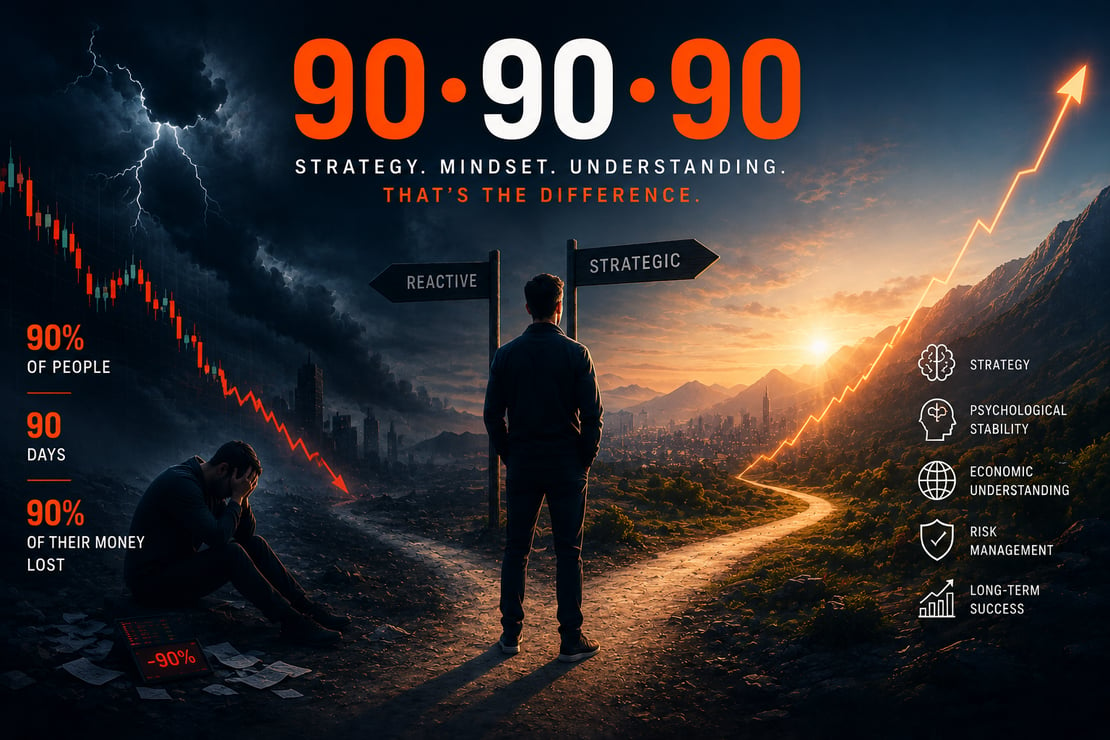
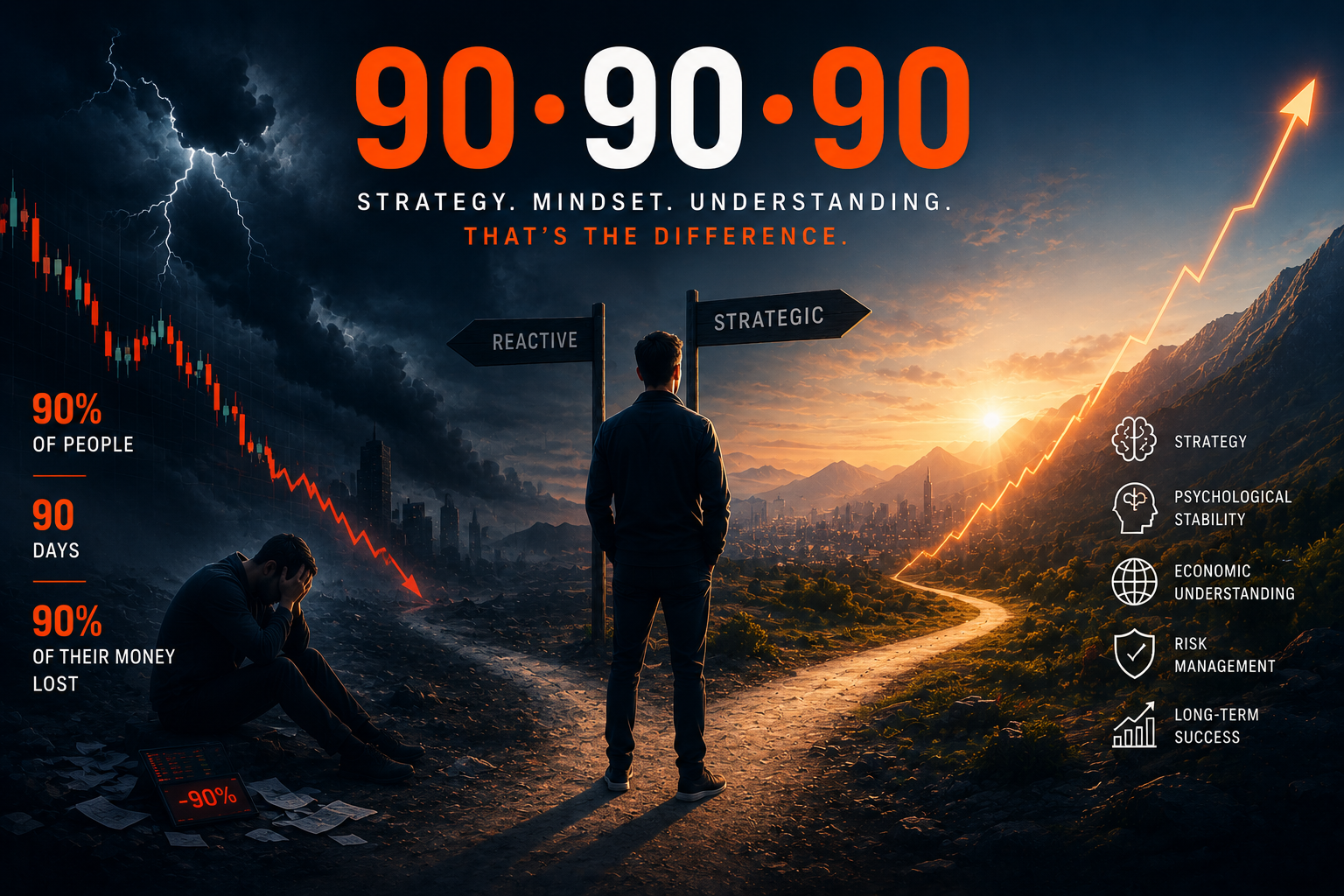
“90% of people lose 90% of their money within the first 90 days of trading.”
Whether the exact numbers are scientifically proven is almost irrelevant.
Because the statement reflects a reality that has been visible for years:
Most people do not fail because of one bad trade or one bad investment.
They fail because they lack:
- a holistic strategy,
- psychological stability,
- and a deeper understanding of how the economy and financial markets actually work.
As a result, many people either:
- lose money very quickly through emotional trading,
or - invest for years in ETFs and traditional portfolios while building far less wealth than they expected.
The Real Problem s Not the Market
Most people believe they only need:
- the perfect ETF,
- the right stock,
- the best trading strategy,
- or a successful influencer to follow.
But long-term financial success is rarely created by:
- a single trade,
- a single stock,
- or a single ETF.
It is created through the combination of:
- strategy,
- psychology,
- risk management,
- adaptability,
- and understanding macroeconomic conditions.
Without those elements, even “good investments” often lead to disappointing outcomes.
Buying ETFs Alone Is Usually Not Enough
ETFs are excellent financial tools.
They are:
- diversified,
- cost-efficient,
- and often outperform many actively managed funds over long periods.
But many investors make one dangerous assumption:
“If I just buy ETFs consistently, financial success will happen automatically.”
Reality is more complicated.
Many investors:
- panic during market crashes,
- stop investing during recessions,
- sell at the worst possible moments,
- constantly switch strategies,
- or underestimate inflation and economic cycles.
And because of emotional behavior, the actual returns many investors achieve are often significantly lower than the returns of the investments themselves.
Morningstar’s famous “Mind the Gap” studies repeatedly showed that investor behavior significantly reduces long-term performance because people react emotionally instead of strategically.
Trading Without Psychological Stability Often Ends in Disaster
The problem becomes even more extreme in trading.
Why?
Because emotions directly influence every decision.
Many traders:
- increase risk after winning streaks,
- revenge trade after losses,
- abandon their system under pressure,
- or overtrade due to fear and greed.
Most traders do not fail because their strategy is terrible.
They fail because they become emotionally unstable during difficult periods.
Professional traders have emphasized for decades that:
- discipline,
- emotional control,
- and risk management
matter more than almost any technical indicator.
Most People Don’t Understand the Bigger Economic Picture
Another major issue:
Many people invest or trade without understanding how the broader economy influences markets.
Financial markets are heavily affected by:
- inflation,
- interest rates,
- central bank policies,
- liquidity,
- geopolitical events,
- employment data,
- consumer spending,
- and corporate earnings.
Someone who simply:
- buys ETFs blindly,
or - trades short-term charts without understanding macroeconomics
often becomes emotionally overwhelmed during volatile periods.
And emotional reactions are usually where the biggest financial mistakes happen.
Weak Phases Determine Who Succeeds
Almost everyone feels confident:
- during bull markets,
- after strong gains,
- or when markets are rising easily.
But the real question is:
What happens when markets become difficult?
Because difficult periods reveal:
- your strategy,
- your emotional resilience,
- your risk management,
- and your true understanding of investing.
Many people:
- panic during crashes,
- abandon long-term plans,
- chase trends,
- or constantly jump from one strategy to another.
A Holistic Wealth Strategy Requires More Than Returns
Long-term financial success requires multiple dimensions working together.
1. Psychology
Can you stay calm:
- during losses,
- in uncertain markets,
- and under emotional pressure?
2. Strategy
Do you have:
- clear rules,
- diversification,
- proper risk management,
- and a long-term plan?
3. Economic Understanding
Do you understand:
- inflation,
- market cycles,
- monetary policy,
- liquidity,
- and macroeconomic trends?
4. Adaptability
Markets constantly evolve.
What worked five years ago may not work tomorrow.
Rigid thinking often becomes dangerous in changing market environments.
The Biggest Risk Is Emotional Decision-Making
Research repeatedly shows:
The largest destroyer of returns is often not the investment itself.
It is human behavior.
Morningstar describes this as the:
“Behavior Gap”
—the difference between:
- the theoretical return of an investment,
and - the actual return investors achieve.
Why does this happen?
Because people:
- buy too late,
- sell in panic,
- chase hype,
- and constantly react emotionally to market movements.
Financial Education Must Be Holistic
Successful investors and traders do not only study:
- charts,
- ETFs,
- or stock picks.
They also study:
- psychology,
- macroeconomics,
- risk management,
- probabilities,
- market structure,
- and emotional discipline.
Because:
Markets do not destroy most people.
Emotional decisions do.
Final Thoughts
The 90-90-90 rule is ultimately not just about trading.
It is a warning.
A warning against:
- operating without strategy,
- ignoring economic realities,
- underestimating psychology,
- and believing that buying ETFs alone automatically creates wealth.
Trading alone is usually not enough.
Buying ETFs alone is often not enough either.
Long-term success requires:
- a holistic strategy,
- psychological resilience,
- economic understanding,
- disciplined risk management,
- and the ability to stay rational during difficult times.
Because in the end, the people who succeed financially are rarely the fastest or the most emotional.
They are usually the ones who remain:
- mentally stable,
- strategically flexible,
- risk-aware,
- and consistently disciplined over time.