

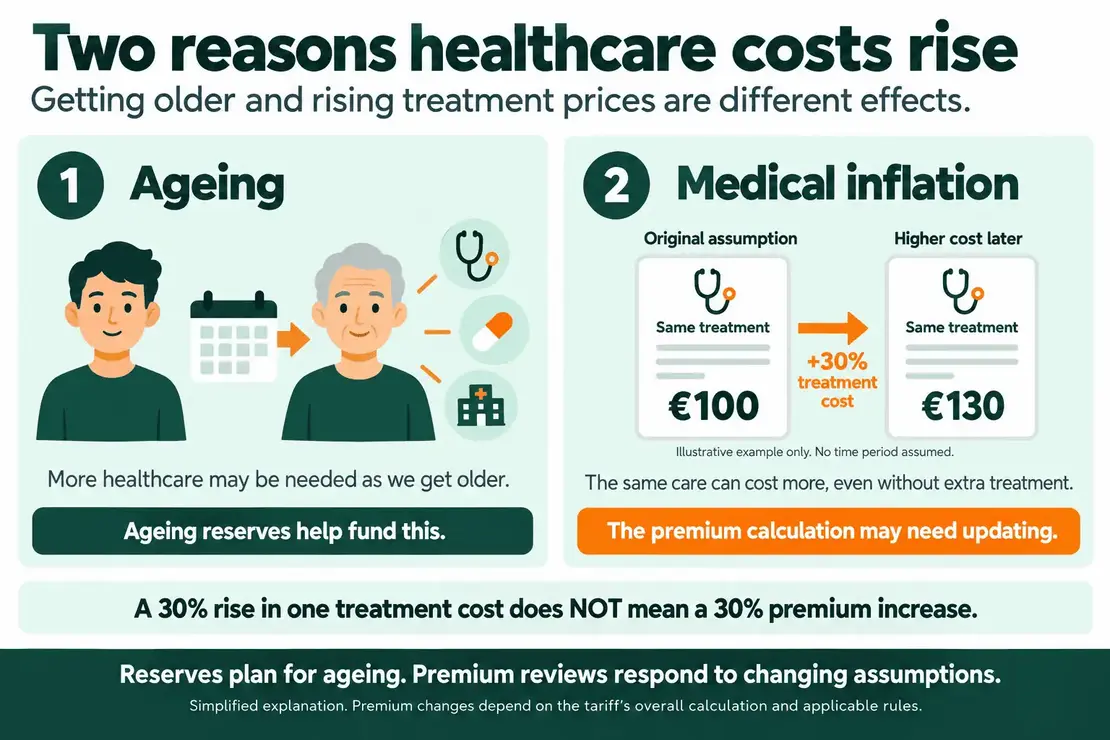
Private health insurance plans for higher healthcare needs in old age. But that does not fix the future price of medical care.
Understanding the difference helps you make a better long-term decision about health insurance in Germany.
“If my private health insurer puts money aside for old age, why does my premium still increase?”
It is a reasonable question. The answer becomes clearer when you separate two developments: healthcare needs change as we get older, and healthcare itself can become more expensive.
Ageing reserves help finance future healthcare. They are not a guarantee that your premium will stay unchanged for life.
In younger years, expected healthcare costs are generally lower than in older years. In a standard private health insurance tariff that builds ageing reserves, part of the premium is therefore set aside to help finance higher expected costs later.
.webp?width=460&height=307&name=Berechnung%20der%20privaten%20Krankenversicherung%20(1).webp)
The orange curve shows expected healthcare costs. The horizontal green line illustrates the original calculated premium if the underlying assumptions remain unchanged.
Early reserves help finance the gap when expected healthcare costs are higher later in life.
Higher healthcare needs in old age are considered from the beginning.
Investment income is also part of the plan
These reserves are called Alterungsrückstellungen. They are invested, and the premium calculation includes an assumed interest rate, known as the Rechnungszins.
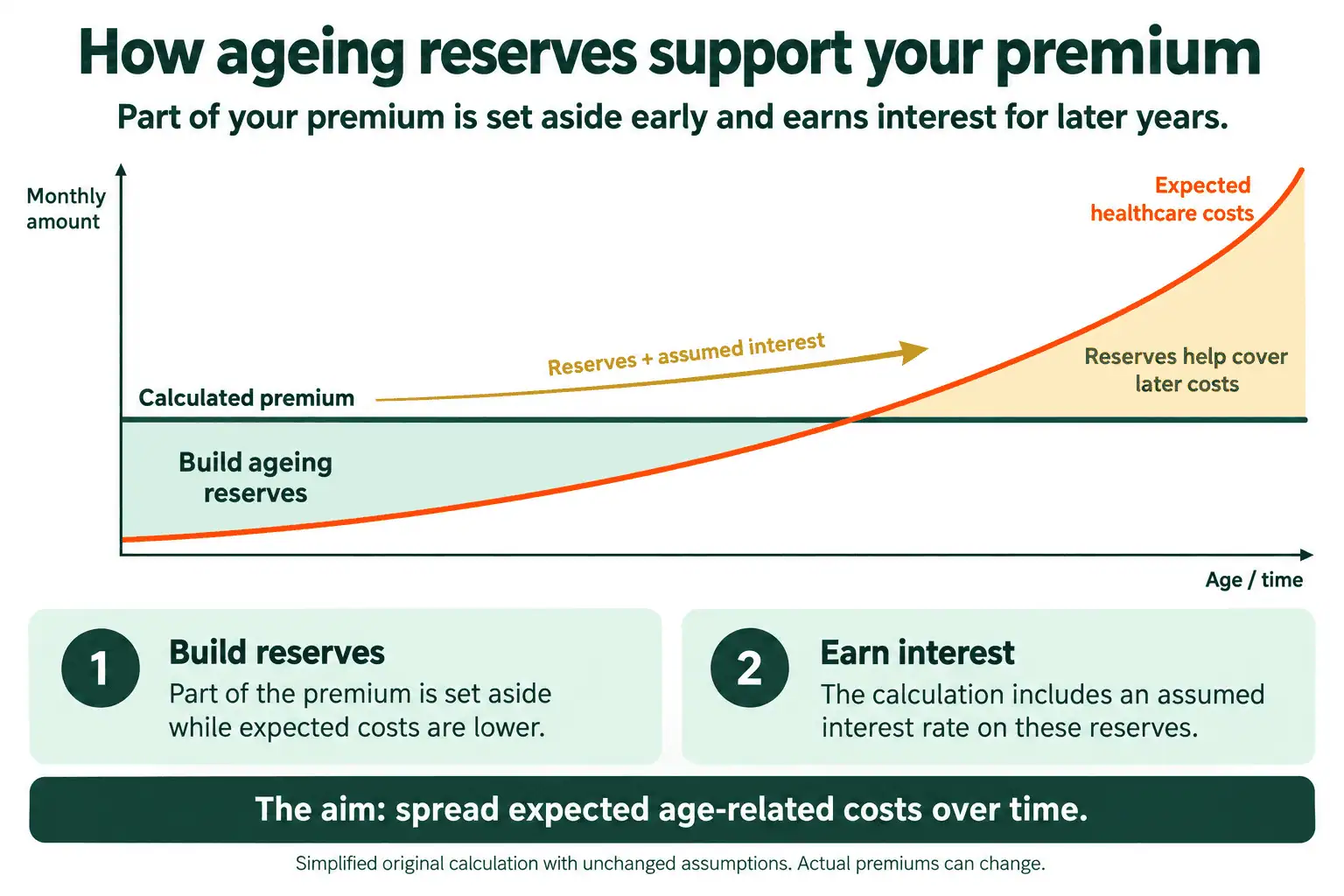
Future benefits are financed through premiums, accumulated reserves and investment income. Actual calculations also consider factors such as mortality, expenses and the tariff’s benefit structure.
The shaded areas simplify the financing principle. They should not be read as exact or equal cash amounts.
Ageing reserves are not a freely accessible balance from which you can withdraw money. They form part of the insurance financing for future benefits.
Needing more care is different from paying more for the same care
As an insured group gets older, it will generally need more healthcare. The original calculation anticipates this age-related pattern.
Medical inflation is a separate effect: the same treatment, medicine or hospital service can become more expensive. The original calculation cannot fix all future healthcare prices.
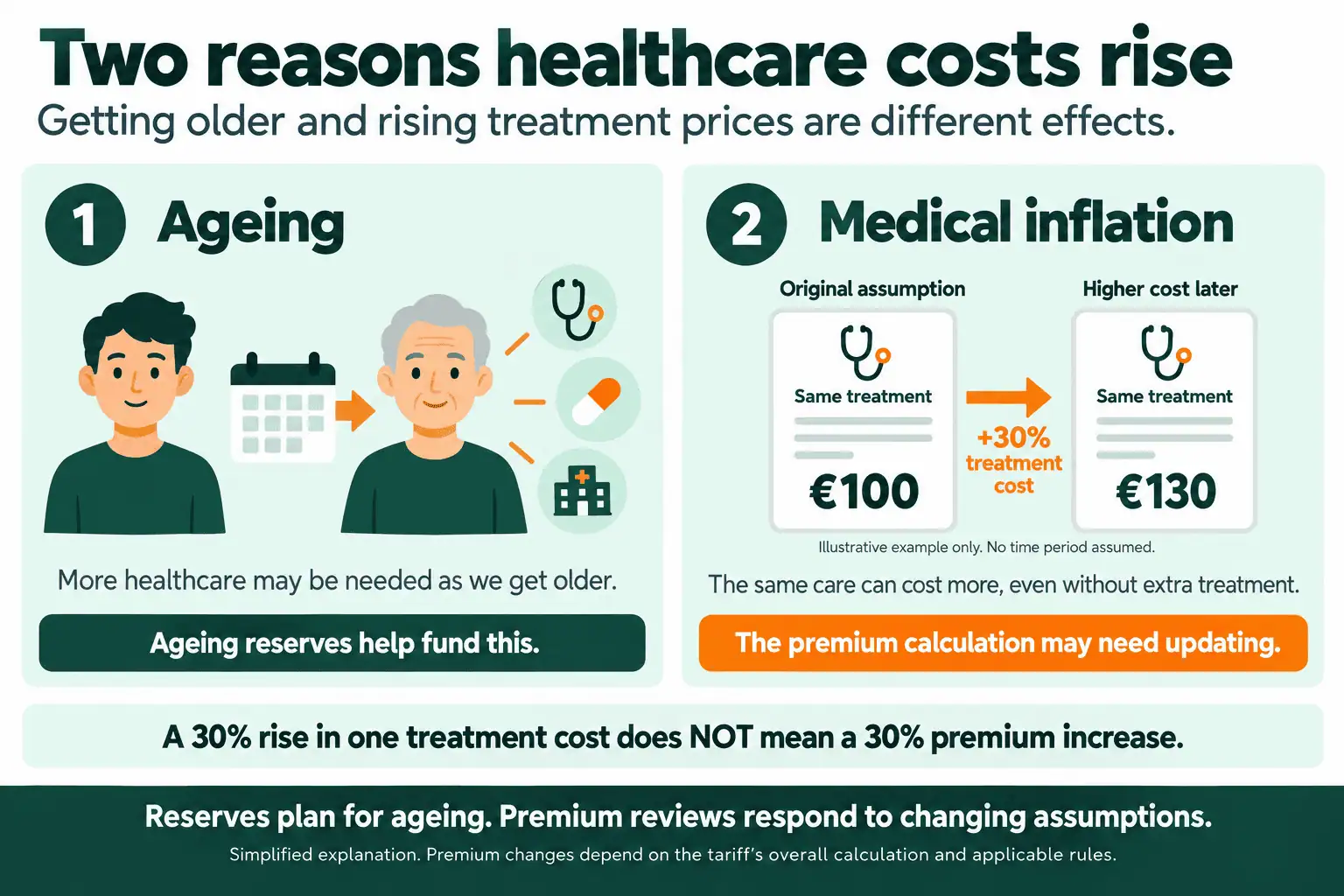
In the illustration, a treatment originally assumed to cost €100 later costs €130. These are not figures for a particular treatment or a forecast.
A 30% increase in the cost of one treatment does not automatically produce a 30% premium increase. The tariff’s overall calculation matters.
Comparing private health insurance?
Look beyond the starting price. We explain benefits, deductibles, ageing reserves and long-term considerations in clear English.
Book a free consultationIf expected healthcare expenditure changes sufficiently, the premium calculation may need to be updated under the applicable adjustment rules.
Reserves continue to help finance future care. However, a higher cost level can also increase the funding needed for later years.
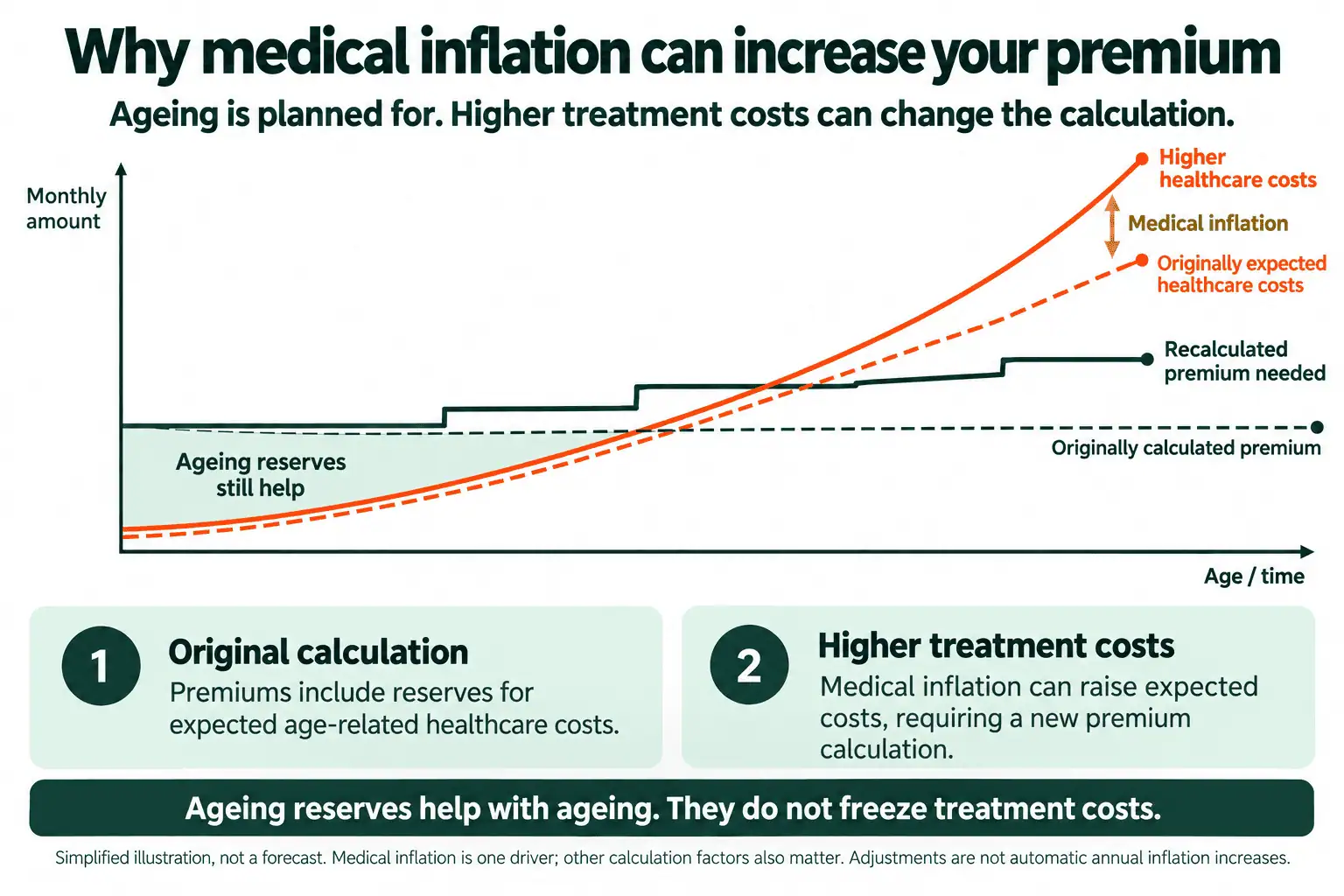
The dashed orange curve represents originally expected costs. The solid orange curve illustrates higher costs. The green lines distinguish the original premium from an illustrative recalculated premium.
PKV premiums are not automatically increased each year by the consumer inflation rate. Adjustments depend on the relevant tariff and legal conditions, with an independent trustee involved.
Medical expenditure is one factor. Changes in mortality assumptions and the recalculation of other factors can also matter.
A premium adjustment is not an individual penalty for having claimed or having become ill. The calculation concerns the relevant insured group.
In private health insurance, the agreed benefits are generally protected by your contract. An insurer cannot simply remove a promised benefit because it has become more expensive to provide.
That promise applies within your policy’s terms, reimbursement limits and exclusions. A limited benefit does not become unlimited just because it is contractually agreed.
Special statutory tariffs and legally permitted changes require separate consideration.
| Question | Private insurance: PKV | Statutory insurance: GKV |
|---|---|---|
| What defines the benefits? | The insurance contract and tariff conditions, within the legal framework. | Legislation and binding healthcare guidelines. Some additional benefits vary by health fund. |
| Can benefits change? | Agreed benefits are generally contractually protected. Specific legal exceptions apply. | The statutory framework can change, including through improvements or restrictions. |
| Is the future contribution fixed? | No. Premium adjustments remain possible. | No. Contribution rates, income limits and individual income can affect payments. |
A statutory health fund cannot simply remove mandatory benefits at will. Equally, a PKV benefit guarantee does not mean that every tariff covers every treatment.
What inflation and the pandemic help explain
Healthcare providers face rising costs too
Higher wages, energy costs and material prices can increase the cost of running hospitals and medical practices. More expensive medicines and changing treatment patterns can add further pressure.
The effect on insured expenditure differs between services. It does not mirror consumer inflation one for one.
This is why inflation is a useful example: even with unchanged contractual benefits, the cost of fulfilling those benefits can rise.
The pandemic shows that expenditure is not a smooth line
COVID-19 changed healthcare demand and the timing of treatment. However, it is too simplistic to claim that total PKV expenditure immediately surged throughout the pandemic.
The PKV Association reports that benefit expenditure grew less strongly during the pandemic than in preceding years.
The pandemic is therefore an example of changing healthcare utilisation, rather than a universal explanation for a particular premium increase. To understand an individual adjustment, review the insurer’s tariff-specific information.
Compare the long-term commitment, not just the starting price
Before choosing private health insurance, consider these questions alongside your personal circumstances:
- Benefits: What does the tariff cover, and where are its limits?
- Long-term affordability: Can your budget accommodate future adjustments and retirement?
- Family plans: How could children or parental leave affect household costs?
- Income protection: Is suitable sickness allowance included for periods without salary?
- Your plans for Germany: What happens if your employment, residence or future country changes?
Contractual benefit protection can be valuable. It does not make PKV the right choice for everyone. A sound comparison considers both public and private insurance and your longer-term plans.
Common questions
Does my premium rise simply because I get one year older?
In a standard adult tariff with ageing reserves, the original calculation already anticipates ageing. This differs from adjustments caused by changed calculation assumptions. Specific age bands or special tariff arrangements should be checked separately.
Are ageing reserves useless if premiums still rise?
No. They continue to help finance age-related costs. An adjustment does not mean the reserves have disappeared or stopped serving their purpose.
Will my premium rise by the inflation rate?
There is no automatic one-to-one link. The relevant tariff’s experience and the legal adjustment conditions determine whether and how recalculation occurs.
Does a guaranteed benefit mean every invoice is paid in full?
No. Reimbursement depends on medical necessity, tariff conditions, fee limits, deductibles and other contractual requirements.
Understand the cover before you compare the price.
Considering PKV or reviewing an existing policy? We help you understand the benefits, the calculation and what matters for your life in Germany.
Book a free PKV consultationRead the complete PKV guide
Sources and further reading
Checked on 15 October 2026. The PKV Association represents private insurers; statutory and legal sources are listed separately.
- PKV Association: Why premiums rise
- PKV Association: Ageing reserves and calculation terminology
- Insurance Contract Act, section 203
- Federal Ministry of Health: Statutory benefit catalogue
- PKV Association: 2024 statistical report
General explanation, not an individual tariff recommendation. Illustrations are simplified and do not predict future premiums.