

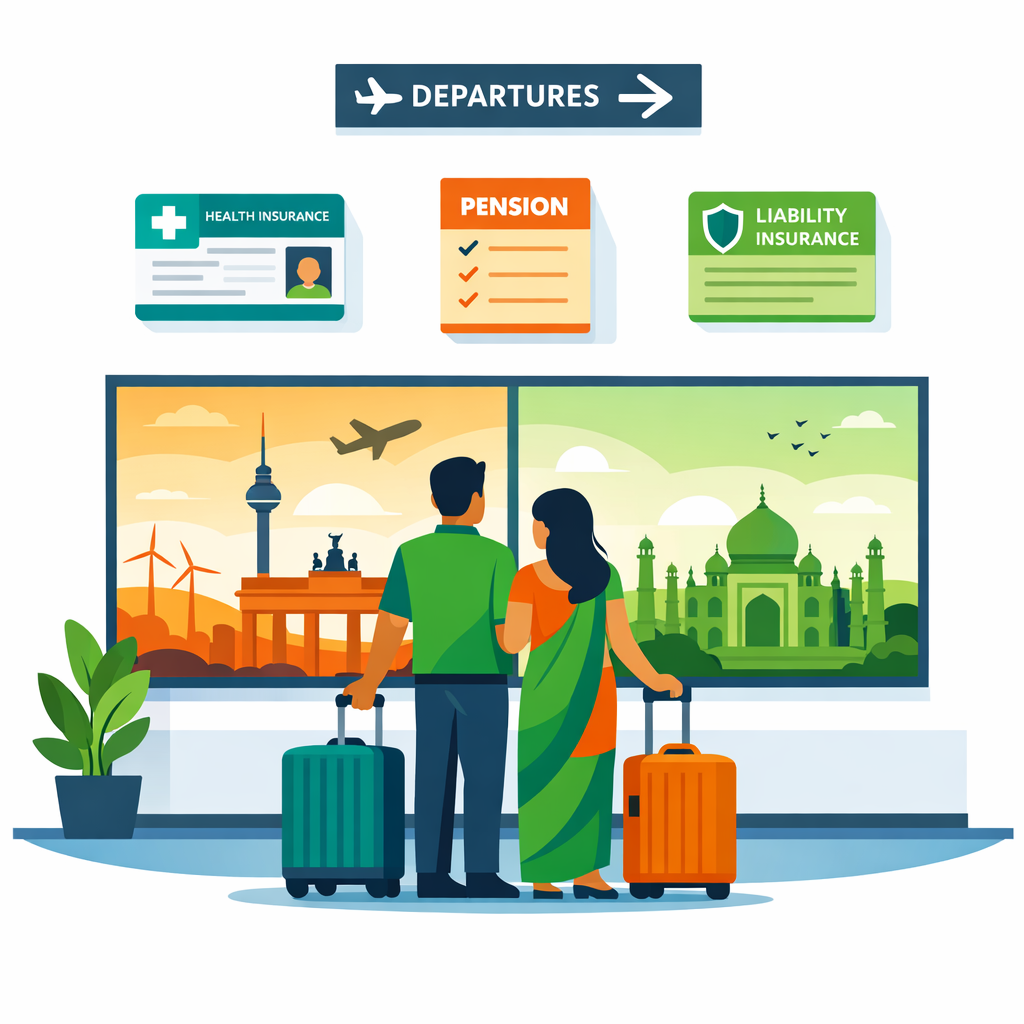
Shows Indian expats how to plan German health, insurance and pension steps before moving back to India.
Why your German insurance and pension still matter when you leave Germany for India.
Moving Back to India: German Insurance & Pension Checklist
Why your German insurance and pension still matter when you leave
For many Indian professionals, Germany starts as a career chapter, not a final destination. You plan to work a few years, gain experience, save in euros and then move back to India or on to another country. Over time, however, you build up more than just savings: you pay into German pensions, sign insurance contracts, maybe buy a car or furnish a flat. When the moment finally comes to move back to India, it is tempting to focus only on flights, schools and shipping boxes. Yet what you do with your German insurance and pensions in the last 6–12 months before leaving can quietly shape your finances for years. Cancel too much, too early, and you risk standing without health cover or liability protection while you still live and work in Germany. Forget to cancel, and you may keep paying for contracts long after you have handed in your residence permit. Ignore your pension letters, and you could lose track of valuable rights that might one day be paid to you in India. Think of your move as closing one financial system and re‑anchoring your life in another. In Germany, your safety net is built around statutory health insurance, the public pension, and a set of private policies such as liability, household contents, accident, disability or company pensions. In India, protection often depends more on family networks, local health plans, EPF or NPS, and individual savings. When you move from one system to the other, your goal is not simply to stop paying in Germany, but to hand over responsibilities in a controlled way. A good starting point is to understand what happens to the German statutory pension when you leave. If you have contributed for at least five years, you normally keep an entitlement that can be paid even if you live abroad later. Official guidance from Deutsche Rentenversicherung, such as the leaflet “Work and pension in Germany and in non‑contracting states” available at Deutsche Rentenversicherung – Working in Germany and in non‑contracting states, shows that even if India has no full social‑security agreement with Germany, you can often receive your pension abroad if you meet the waiting period. This does not mean you should base your whole retirement on German benefits. But it does mean that before you leave, you should check your pension record, correct any missing periods and update your address so that letters still reach you in India. At the same time, you can discuss with an advisor how your German pension will interact with EPF, NPS or other Indian investments. In parallel, review your private insurances with a “Germany–India bridge” mindset. Ask simple questions:- Will this policy still protect me or my family after we move – and do I want that?
- Does the insurer allow a move abroad, or must I cancel on the day I de‑register?
- Is there a smart way to pause or reduce cover in case I return to Germany later?
How moving back to India changes your German health insurance, liability cover, household policies and other everyday protections.
How moving back changes your German insurance and everyday cover
When you first came to Germany, you probably spent a lot of energy setting up health insurance, registration, bank accounts and maybe liability or contents cover. Moving back to India is the mirror image of that process. If you simply book flights and pack boxes without looking at your German contracts, you may either lose money or accidentally create gaps in protection while you still have responsibilities in both countries. The biggest piece is health insurance. While you live and work in Germany, your health cover is normally tied to your job and residence. When you give up your flat and de‑register (Abmeldung) with the local authority, your legal obligation to have German health insurance ends – but your insurer will not automatically know your plans. You need to inform them in writing, usually with a copy of your Abmeldung and your planned move date. If you are in statutory public health insurance, your membership will typically end at the end of the month in which you move away, once you have shown proof that you are leaving Germany permanently. Independent guides, such as the article on cancelling statutory health insurance for foreigners at Visaguard – Cancelling health insurance as a foreigner in Germany, explain the formalities: at least two months’ notice, written confirmation, and proof that you will no longer be subject to German compulsory insurance. Private health insurers have their own rules, but also expect clear documentation. For many Indian families, a key question is whether to keep some link to the German system in case they return later. One option discussed in long-stay guides, such as the overview from the European Consumer Centre at EVZ – Längerer Auslandsaufenthalt und Krankenversicherung, is an Anwartschaft (suspension) in private health insurance. You pay a reduced premium to preserve your right to re‑enter the system later without a new medical check. This can be attractive if you know you might return to Germany within a few years and already have a good private tariff. For most employees in statutory insurance, however, it is more realistic to end the contract cleanly and rely on regular re‑entry rules if you ever come back. Beyond health insurance, you should review other everyday policies:- Private liability insurance: If you keep a rented flat for a few months while between countries, it still makes sense to stay insured. Once you fully hand back the keys and no longer live in Germany, you can usually cancel with proof of move abroad.
- Household contents insurance: Adjust sums insured when you sell or ship furniture. As soon as you no longer own insured property in Germany, cancel the policy.
- Car insurance: De‑register the car before you leave. The registration office informs your insurer; any overpaid premium is normally refunded.
- Legal protection or accident insurance: Check whether policies still cover you abroad and whether you want to keep them during the transition period.
Step-by-step checklist for closing, keeping or restarting German insurance and pensions when you leave, so your move home supports your long-term India–Germany plans.
Your step-by-step checklist for a safe move home
By the time you have a firm moving date, your goal is to turn many small to‑dos into one clear checklist. Think in three phases: before you resign and de‑register, between your last working day and your flight, and your first months back in India. Before resignation and Abmeldung- Make a complete list of your German contracts: health, liability, household, car, accident, legal protection, mobile, internet, gym, subscriptions.
- Order the latest pension statements from Deutsche Rentenversicherung and from any company pension schemes so you see exactly what you have built up.
- Read at least one neutral guide on pensions and moving abroad, such as the Deutsche Rentenversicherung leaflet on working in non‑contracting states at Work and pension in Germany and in non‑contracting states.
- Decide with your family whether the move is permanent or whether you may return to Germany in a few years. This affects whether options like Anwartschaft for private health insurance make sense.
- Notify your statutory or private health insurer of your planned move date and ask which documents they need to end or suspend cover.
- Send cancellation letters for other insurances that you no longer need once you leave; attach proof of move abroad where required.
- De‑register your address and, if relevant, your car. Keep all confirmation letters.
- Decide what to do with German bank accounts: keep at least one for receiving any future pension payments and tax refunds, but close unused accounts and credit cards.
- Store digital copies of all German insurance and pension documents in a secure cloud folder or Neodirect client portal so you can access them easily from India.
- Confirm that your German health insurance has ended on the correct date and that no unexpected premiums are still being collected.
- Check that you have written confirmation of your accrued German pension rights and that Deutsche Rentenversicherung has your new Indian address; the international portal at Deutsche Rentenversicherung – International gives contact details.
- Set up or adjust Indian health, life and accident policies to reflect your new euro‑to‑rupee income and your experience of the German system.
- Update your long‑term financial plan to include both Indian assets and future German pension payments, using conservative exchange‑rate assumptions.
Learn more about Rürup pension (Basisrente) for expats in Germany on our website, and how Neodirect advisors can help you choose the right cover.
Ready to get the right cover? Book a free consultation with a Neodirect advisor — we help Indian expats and international professionals in Germany navigate insurance in clear English.