
This image was created using AI and is used for decorative or illustrative purposes only.
AI generated picture for Illustration
Last reviewed: 6 September 2026
If you have worked in Germany for several years and plan to leave the country permanently, you may face an important financial decision: Should you keep your German pension rights or, if legally possible, apply for a contribution refund?
This question becomes especially important if you are close to completing 60 months in the German statutory pension system.
At first, the choice may seem simple: receive money today or keep a monthly pension for many years in the future.
That comparison, however, leaves out several important factors.
Your age, pension points, contribution months, family situation, future pension adjustments, investment returns, inflation and life expectancy can all change the outcome.
Why do the 60 months matter so much?
The German statutory pension generally requires a five-year qualifying period before a regular old-age pension can be paid.
It is important to check your actual insurance record rather than simply counting how many years you have lived or worked in Germany.
For people who plan to leave Germany permanently, reaching 60 German contribution months may have another important consequence: it can affect whether a contribution refund is still possible.
The exact rules depend on factors such as nationality, future country of residence, insurance status and applicable social security agreements.
For an Indian citizen who plans to return permanently to India, for example, the German-Indian Social Security Agreement may be relevant.
That is why the difference between 59 and 60 months can be so important.
If you are close to the 60-month threshold, do not make an irreversible decision before speaking directly with Deutsche Rentenversicherung (DRV).
What are German pension points?
To understand the financial side of the decision, it helps to understand German pension points, known as Entgeltpunkte.
In simplified terms, if your pensionable annual income is close to the relevant German average income, you earn approximately one pension point for that year.
If you earn more, you generally receive more points. If you earn less, you receive fewer points, subject to the rules and contribution limits of the German pension system.
The pension points you have accumulated are important because they determine a substantial part of your future German pension.
Leaving Germany does not automatically make these pension points disappear.
Example: 8.2 German pension points
Consider the following example.
The person is:
- 37 years old
- married
- planning to return permanently to India
- close to completing 60 German contribution months
- has approximately 8.2 pension points
- and estimates a possible contribution refund of €30,000
Before making any financial comparison, Deutsche Rentenversicherung should confirm whether the estimated €30,000 refund is correct.
A contribution refund does not necessarily mean that you receive everything that you and your employer have paid into the German pension system.
For that reason, never make this decision based only on an estimated refund amount.
What are 8.2 pension points worth?
Using a current pension value of approximately €42.52 per pension point, the calculation is:
8.2 × €42.52 = approximately €349 per month.
For simplicity, we can therefore describe the present-day value as approximately €350 per month.
There is an important misunderstanding to avoid here:
If you are 37 today, this does not mean that you will necessarily receive only €350 nominally when you retire approximately 30 years from now.
German pension values are adjusted over time according to the applicable statutory rules.
What might €350 become over 30 years?
Nobody can accurately predict future German pension adjustments.
To compare different financial scenarios, however, we can use a simple assumption.
Let's assume an average pension adjustment of 2% per year.
This is an illustration only, not a forecast or a guarantee.
The calculation would be:
€350 × 1.0230 ≈ €634 per month.
Under this assumption, today's €350 pension value would correspond to approximately €634 per month at age 67.
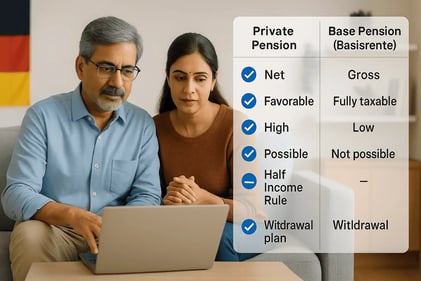
Want to build additional retirement income?
The German statutory pension can be one part of your retirement strategy. A private pension can provide additional flexibility, investment opportunities and retirement income, especially if you plan to live outside Germany later.
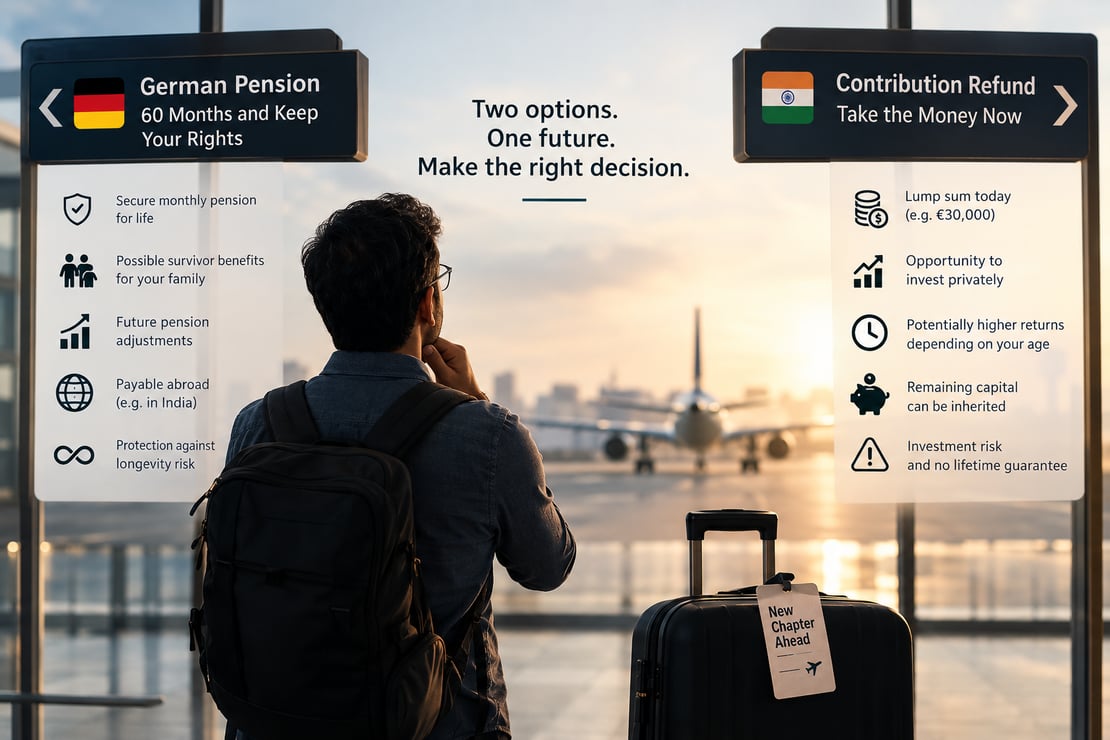
€30,000 today or €350 per month later?
This is where a simple comparison can become misleading.
If we assume €350 per month for 20 years:
€350 × 12 × 20 = €84,000.
The simple nominal break-even point compared with €30,000 would be:
€30,000 ÷ €350 = approximately 86 months.
That equals approximately 7.1 years of pension payments.
However, this calculation leaves out one of the strongest arguments for taking the money today: the €30,000 can be invested.
That is why compound interest also needs to be considered.
Why does your age make such a difference?
The younger you are when you receive a possible contribution refund, the longer your money may have to grow before retirement.
Consider €30,000 invested until age 67:
| Age today | Years until 67 | 4% return | 5% return | 6% return |
|---|---|---|---|---|
| 30 | 37 | approx. €128,000 | approx. €183,000 | approx. €259,000 |
| 37 | 30 | approx. €97,000 | approx. €130,000 | approx. €172,000 |
| 45 | 22 | approx. €71,000 | approx. €88,000 | approx. €108,000 |
| 55 | 12 | approx. €48,000 | approx. €54,000 | approx. €60,000 |
These are illustrative calculations before taxes, investment costs and market fluctuations.
They show why the age at which you leave Germany can significantly change the financial comparison.
A 30-year-old who receives a contribution refund has decades in which compound growth may take effect.
Someone leaving Germany at 55 has far less time before retirement.
What investment return would be needed?
Let's return to the 37-year-old example.
Assume the person receives €30,000 today and invests it for 30 years.
At age 67, the investment would then need to provide an income comparable to the German pension until age 87.
If we assume that today's €350 pension develops at an average rate of 2% per year, it would start at approximately €634 per month at age 67.
If we also assume continued 2% annual increases during retirement, our simplified model shows that the €30,000 private investment would need to generate approximately 4.7% per year over the long term to reproduce a comparable payment stream until approximately age 87.
That return would need to be achieved not only before retirement, but also while money is being withdrawn during retirement.
There are also several other factors to consider:
- investment costs
- taxes
- market fluctuations
- the timing of market crashes
- inflation
- and the possibility of living longer than expected
What if you live until 90, 95 or 100?
This is one of the biggest differences between private capital and a statutory pension.
Private capital can eventually run out.
If your financial plan assumes that the money only needs to last until age 87 but you live until 97, you would suddenly need another ten years of retirement income.
The German statutory old-age pension, once the legal requirements have been fulfilled and the pension has started, is generally paid for life.
This protection against longevity risk has a financial value of its own.
Private capital, however, also has an important advantage: remaining capital can generally be inherited.
Neither option should therefore automatically be described as better.
Are you married? Your family matters too
If you are married, the comparison should not focus only on your own retirement income.
Subject to the applicable legal requirements, the German statutory pension system can provide survivor benefits for a spouse and potentially for children.
Keeping German pension rights can therefore potentially include an element of financial protection for your family.
If you choose a contribution refund and invest the money privately, your family's protection works differently.
The remaining investment capital can potentially be inherited, but you may need additional insurance or financial planning to replace survivor protection.
This should be part of any serious comparison.
How do inflation in Germany and India affect the decision?
If you plan to retire in India, you cannot evaluate your future purchasing power using German inflation alone.
Your German pension would be calculated in euros, while most of your future expenses would probably be in Indian rupees.
Your actual purchasing power will therefore depend on several factors:
- German pension development
- inflation in Germany
- inflation in India
- the EUR/INR exchange rate
- and your personal cost of living in India
Indian and German inflation can develop very differently.
Exchange-rate movements can also compensate for or amplify these differences.
Nobody can responsibly predict the EUR/INR exchange rate or the inflation differential 30 or 40 years into the future.
These factors should therefore be treated as scenarios rather than certainties.
The most important step: speak to Deutsche Rentenversicherung
If you are close to 60 months, do not make this decision based only on calculations from the internet, friends, Facebook groups or financial advisers.
Make a personal appointment with Deutsche Rentenversicherung before leaving Germany.
Take your complete insurance record with you and explain your situation clearly:
- your nationality
- your planned permanent move abroad
- your future country of residence
- your family situation
- and that you are close to completing 60 months
Questions you should ask DRV
- How many qualifying German insurance months do I currently have?
- On which exact date will I complete 60 months?
- How many German pension points have I accumulated?
- What pension entitlement do these pension points currently represent?
- If I leave Germany before completing 60 months, am I legally entitled to a contribution refund?
- What exact amount would I receive?
- Which contributions would be refunded and which would not?
- Which pension rights would I lose through a contribution refund?
- What changes if I complete 60 months before moving permanently to India?
- Would completing 60 months prevent a future contribution refund?
- Can my future German pension be paid while I live permanently in India?
- What survivor benefits could potentially apply to my spouse?
- What benefits could potentially apply to my children?
- How does the German-Indian Social Security Agreement affect my individual situation?
Do you want to compare your retirement options?
Once Deutsche Rentenversicherung has confirmed the exact figures, the next step is to compare your German pension entitlement with your private retirement and investment alternatives.
We can help you understand the financial side and build a retirement strategy that fits your plans in Germany and abroad.
Conclusion: don't ask only “€30,000 or €350?”
The real question is not:
“Should I take €30,000 today or €350 per month later?”
The better question is:
“What pension and insurance value would I give up through a contribution refund, and what investment return would I need to generate privately to replace that value?”
There is no universal answer.
A 30-year-old is in a different financial position from a 55-year-old because the younger person has much more time for compound investment returns.
A married person with children has different protection needs from a single person.
Someone with 58 or 59 contribution months faces a very different decision from someone who has contributed for only two years.
Your age, pension points, contribution months, actual refund amount, family situation, investment return, destination country and life expectancy all belong in the calculation.
If you are close to completing 60 months, the first step should therefore always be:
Book an appointment with Deutsche Rentenversicherung, get your exact figures and legal position confirmed, and only then make the financial decision.
Your pension decision can affect the next 30 or 40 years
Don't make it based on an estimate. First get your exact DRV figures. Then build a retirement strategy around the facts.
Official pension sources
For the official rules and your individual situation, see these Deutsche Rentenversicherung sources:
- Minimum insurance periods and qualifying periods — the official overview explains how qualifying periods are counted in months.
- FAQs on refunds of German pension contributions (German).
- International pensions and payment abroad — information from Deutsche Rentenversicherung for people who live or have worked outside Germany.
- Working in Germany and in India: the German–Indian Social Security Agreement (English PDF).
Important: This article provides general information and illustrative calculations only. It does not constitute legal, tax or investment advice and does not replace an individual assessment by Deutsche Rentenversicherung. Pension eligibility, contribution refunds and benefits depend on the individual insurance record and personal circumstances. Investment returns and pension adjustments used in examples are assumptions and are not guaranteed.