

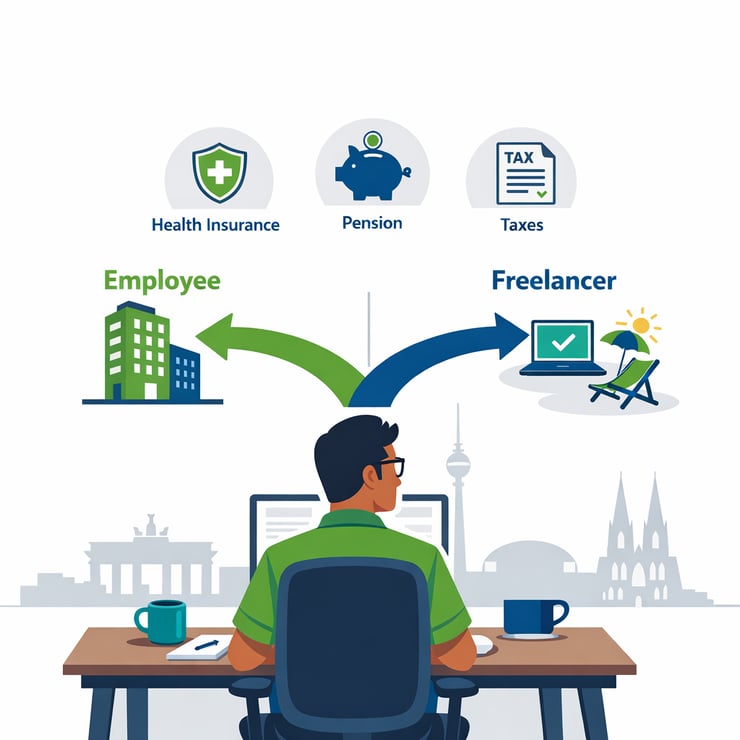
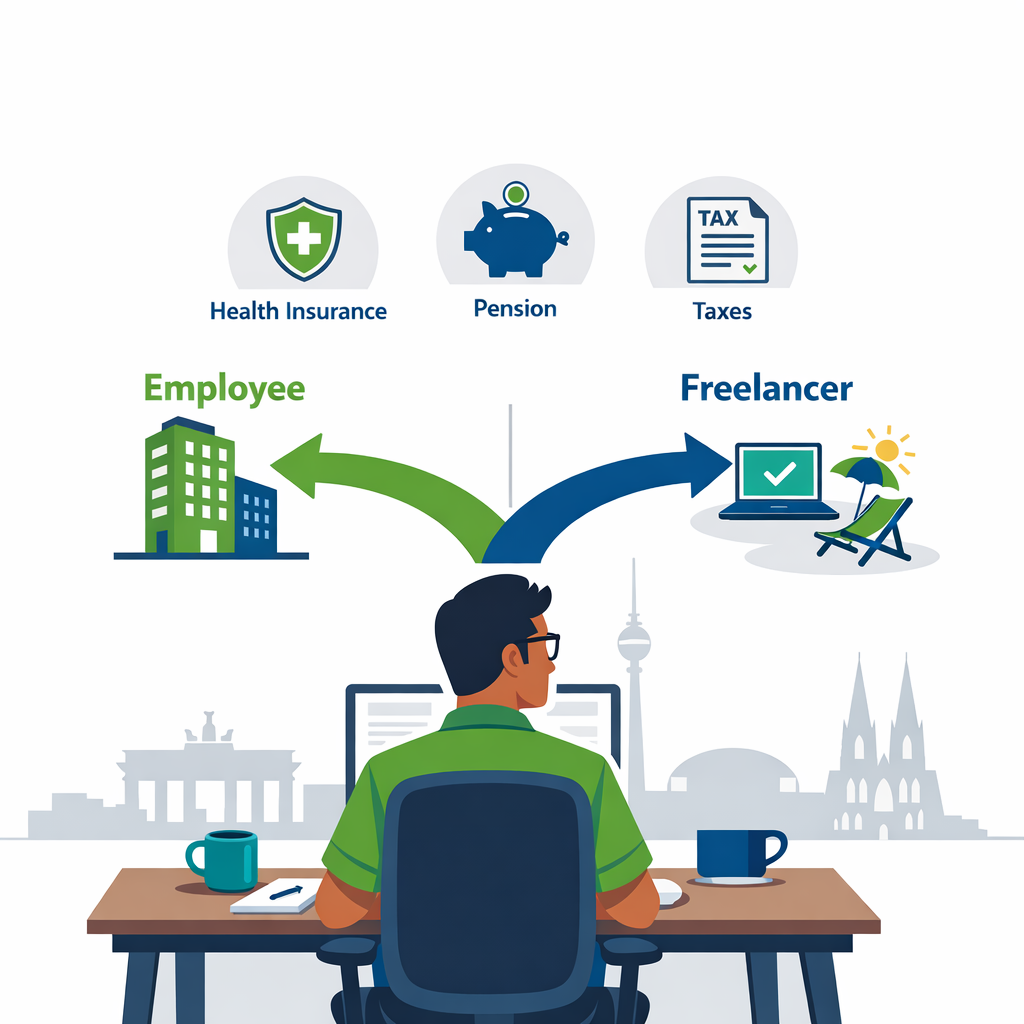
After a few intense years in Germany, many Indian professionals feel the pull of home again. You might want to spend several months with ageing parents, let your children experience school life in India, or take time to reset your career before the next big step.
A 6–12 month break in India can be a wonderful idea, but from the perspective of German insurance and pensions, it is not as simple as booking a long holiday. German rules make a clear difference between living in Germany and visiting from abroad. For broader orientation, see how the German insurance system works.
Health insurance is mandatory for residents, while pensions, unemployment benefits, and many tax rules depend on where you work and where you are registered. A normal tourist trip of a few weeks is clearly a visit. A half-year stay while you are still officially living or insured in Germany is a grey zone where problems can appear later if you do not plan carefully.
Your financial responsibilities usually also stretch across two countries. Your euro income may support rent and childcare in Germany, parents’ medical costs and loans in India, and investments in both currencies. If you switch off German protection without building Indian protection, a serious illness or accident during your break could damage that entire bridge.
A helpful way to think about the break is as a temporary flip of your “main country”. For a defined period, India becomes where you physically live; Germany is where you may still have contracts, rights, and future plans. Your task is to make sure that during this time you are clearly and continuously insured somewhere, and that your German pension and other long-term benefits are preserved.
Independent, official, and semi-official sources highlight the complexities of long stays abroad. The European Consumer Centre Germany, for example, explains in its guide on long-term stays that whether you can remain in German statutory health insurance depends on your employment status, residence, and the purpose of your stay abroad, as shown at EVZ – Längerer Auslandsaufenthalt. Visa-focused advisors like Visaguard also emphasise that cancelling German health insurance as a foreigner requires clear proof of moving abroad or switching systems, not just personal preference.
This article looks at your India break in three layers. First, it explains how different types of breaks — unpaid leave, sabbaticals, quitting with or without de-registration — change insurance and pension rules. Then it gives practical checklists for keeping your Germany–India safety net organised before, during, and after your time away.
The goal is to help you enjoy your months in India fully, while staying confident that your German health insurance, pensions, and other protections will still support your long-term plans when you return.
How your break changes rules
From an insurance and pension point of view, not all “breaks” are the same. Before you book tickets, you need to decide how you will step out of German work.
Three patterns are common for Indian expats:
- Unpaid leave or sabbatical with a job waiting.
- Quitting your job but staying registered in Germany.
- Quitting and de-registering (Abmeldung) before going to India.
Each path changes how health insurance, pension contributions, and other protections behave. If you take formal unpaid leave but remain employed, you may still be part of the statutory health-insurance system, depending on your contract and income rules. Some employers continue to pay contributions for a limited period; others require you to pay the full amount yourself.
EU consumer guidance on long stays abroad, such as the overview at EVZ – Längerer Auslandsaufenthalt und Krankenversicherung, shows that much depends on whether you keep your main residence in Germany and whether your stay is considered temporary.
If you quit your job but stay registered at your German address, you remain subject to the general obligation to have health insurance. That means you must either continue statutory or private coverage as a voluntary member, or arrange another form of recognised cover.
You may need to pay full statutory contributions based on notional minimum income, which can feel expensive during a career break but preserves continuous cover and future rights. Guidance on changing or cancelling statutory insurance for foreigners, such as the article from Visaguard at Cancelling health insurance as a foreigner in Germany, makes clear that you cannot simply stop paying; you must show a new basis for exemption.
If you de-register in Germany before leaving and move your main residence back to India, you usually leave the German health-insurance system entirely. Statutory funds will end your membership once you provide proof of Abmeldung and relocation; private insurers may allow cancellation or a reduced Anwartschaft (suspension) premium to keep the door open for a later return.
EU-focused guides like the EVZ article emphasise that for people living permanently outside the EU, staying in German statutory cover rarely makes sense, but there can be exceptions if a return is clearly planned.
Your pension picture changes more slowly. As soon as you stop paying into the German statutory pension, your existing rights stay frozen but continue to be indexed.
Official information from Deutsche Rentenversicherung’s international portal at Deutsche Rentenversicherung – International explains that contribution-free periods do not usually destroy your entitlements; they just stop them from growing. For a 6–12 month break, the impact on your long-term pension is usually small, but it is a good moment to check your record and consider voluntary contributions if you have longer gaps.
Other insurances
- Private liability and household contents: Often still useful if you keep a flat or belongings in Germany, but can be reduced or cancelled if you fully move out.
- Occupational disability and life insurance: Many contracts continue to protect you worldwide during a temporary stay abroad, which can be valuable if your family depends on your income. Check territorial clauses and notification duties.
- Accident or travel insurance: May need to be upgraded or adjusted to fit longer, non-tourist stays in India.
Because there is no single “correct” structure, the best approach is to map your planned break against your visa, tax, and residency status. Once you know whether Germany or India will be your main country during those months, you can design an insurance mix that matches reality instead of pushing you into grey zones.
If these distinctions feel confusing, a short, free call with an English-speaking Neodirect advisor can help you choose a structure that keeps you legal, insured, and flexible for your return.
Organise your documents
To turn the theory into something you can actually use, it helps to work with concrete checklists. Here is a simple framework you can adapt for your own India break.
Three to six months before departure
- Decide which type of break you will take (unpaid leave, sabbatical, quitting, de-registering) and confirm this with HR and, if needed, a tax advisor.
- Ask your health insurer in writing how contributions and benefits will work during your planned time in India, given your employment and residency status.
- Order an up-to-date pension statement from Deutsche Rentenversicherung and note your total contribution years and projected pension; use the international portal at Deutsche Rentenversicherung – International if you already have cross-border questions.
- List all your German insurance contracts and classify them as “must keep”, “can pause”, or “should cancel” during the break.
One to two months before departure
- Send formal notices to insurers where you will change or cancel cover; attach proof of sabbatical approval or planned Abmeldung if required.
- Set up or top up a euro-denominated emergency fund that will remain accessible from India, ideally equal to three to six months of your German-level expenses.
- Arrange medium-term international health cover or Indian health insurance that fits the length and nature of your stay.
- Store digital copies of all German policies, pension statements, and key emails in a secure cloud folder or Neodirect client portal, and share access with a trusted person.
During your stay
- Keep an eye on bank accounts for any unexpected German insurance debits; question them immediately before small amounts accumulate.
- Use your India-based health and accident insurance as the first line of support; rely on German cover only where contracts explicitly allow it.
- Update Neodirect or your advisor if your plans change — for example, if you extend the break or decide not to return to the same employer.
Before you return
- Contact your previous or future German health insurer early to clarify how you will re-enter the system and what documents you will need.
- Check whether any suspended contracts, for example Anwartschafts for private health insurance, should be reactivated and on which date.
- Review your pension position and, if you have the budget, consider making voluntary contributions to close any larger gaps.
- Rebuild or adjust your German insurance setup — health, liability, contents, income protection — so that your first weeks back feel secure.
Throughout this process, remember that you do not have to make every decision perfectly. What matters most is that you remain continuously insured somewhere, keep official institutions informed of your status, and avoid silent gaps that could cause problems for visas, claims, or pensions later.
If you ever feel stuck, you can book a short, free call with an English-speaking Neodirect advisor to review your personal checklist and make sure your India break strengthens, not weakens, your long-term security.
It also helps to keep all German and Indian insurance and pension documents in one digital overview, such as a secure app or client portal, so you can find everything quickly when needed.



.webp?width=500&height=281&name=Best%20Household%20Content%20Insurance%20Germany%20(1).webp)