

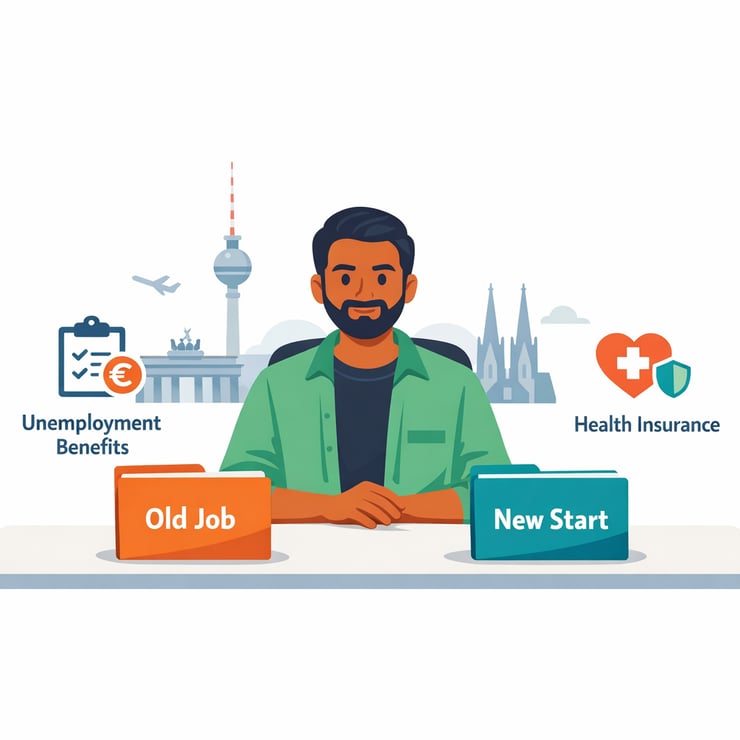
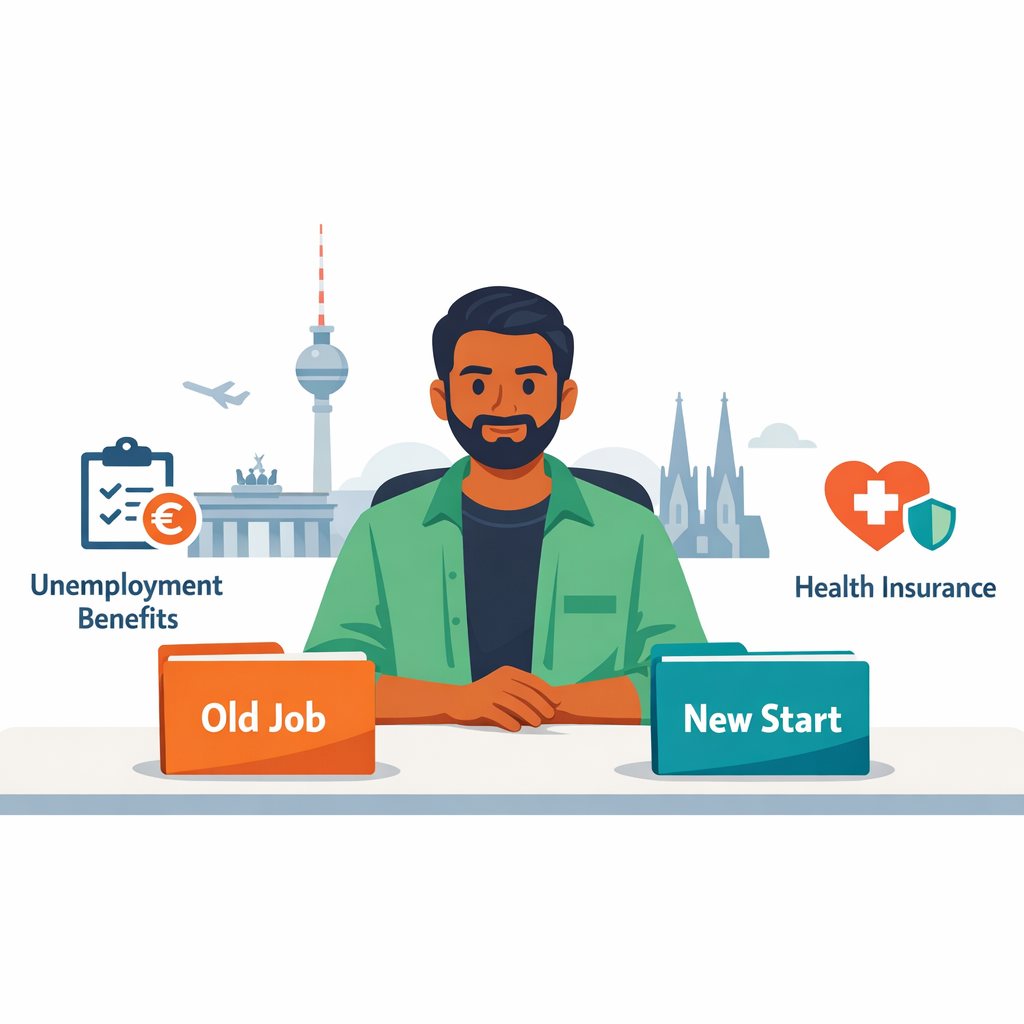
Losing a job in Germany can feel overwhelming—especially for Indian expats on a Blue Card or skilled worker visa. Questions about unemployment benefits, health insurance, residence status, and financial obligations in India often come up immediately.
The good news: Germany offers a structured safety system. If you understand how it works, you can protect your income, stay legally compliant, and avoid long-term financial damage.
This guide explains everything Indian professionals need to know about unemployment benefits in Germany, including ALG I, health insurance, pensions, and how to stay financially stable.
How unemployment benefits (ALG I) work in Germany
Arbeitslosengeld I (ALG I) is the main unemployment benefit for employees in Germany.
You qualify if:
- You worked at least 12 months in the last 30 months
- You paid into unemployment insurance
- You are actively looking for a job
How much will you receive?
- 60% of your last net salary
- 67% if you have children
Example:
If your net salary was €3,000, you receive around €1,800 per month.
How long will you receive it?
- 6 months (after 12 months of work)
- Up to 12 months (after 24 months of work)
Important deadlines:
- Register as job seeker within 3 days after notice
- Register as unemployed on your first day without a job
Missing deadlines can reduce your benefits.
Health insurance after job loss in Germany
Health insurance remains mandatory during unemployment, but the insurance system does not always continue unchanged.
Receiving ALG I generally creates compulsory statutory health insurance under §5(1) no. 2 SGB V. The Federal Employment Agency generally pays the applicable contributions. Someone who was previously privately insured may therefore become insured in the GKV rather than simply remaining in the same PKV arrangement.
A person who was not statutorily insured during the preceding five years and has equivalent private cover may be able to apply for an exemption under §8(1) no. 1a SGB V. The application deadline is generally three months from the start of compulsory insurance, and an exemption cannot be revoked. This makes individual review important before applying.
For people over 55, §6(3a) SGB V can prevent new compulsory GKV membership when its detailed prior-insurance conditions are met. It is not a blanket rule that every person over 55 must remain in PKV, nor that a return to GKV is impossible in every case.
If you do not receive ALG I, the result depends on your existing status and circumstances. Contact your Krankenkasse or private insurer promptly to clarify continuation, contributions and any available options. For broader PKV decision context, see our Private Health Insurance Guide for Expats.
Blue Card and residence permit after job loss
If you are on a Blue Card, your residence is linked to your job.
What happens if you lose your job?
- You must inform the immigration office (Ausländerbehörde)
- You usually have 3–6 months to find a new job
The longer you have lived in Germany, the more flexibility you gain—especially if you are close to permanent residency.
Pension impact during unemployment in Germany
Your pension (Rentenversicherung) continues, but at a lower level.
If you receive ALG I:
- Contributions continue via the government
- You earn fewer pension points
If you receive no benefits:
- No contributions are paid
- This creates gaps in your pension history
For Indian expats, Germany’s social security agreement with India ensures your contributions are not lost.
Biggest financial risk: loss of income beyond unemployment
Many Indian expats focus only on job loss—but the bigger long-term risk is loss of earning ability due to illness or disability.
Unlike unemployment, this risk is not fully covered by the state.
That’s where Berufsunfähigkeitsversicherung (BU) becomes critical.
A BU insurance protects your income if you can no longer work in your profession due to health issues—something ALG I does not cover.
👉 Learn how disability insurance (BU) protects your income in Germany
This is especially important for IT professionals, where even mental health or burnout can impact your ability to work long-term.
Step-by-step checklist after losing your job
1. Register immediately
- Job seeker (arbeitssuchend)
- Unemployed (arbeitslos)
2. Apply for unemployment benefits (ALG I)
3. Confirm your health insurance status
4. Inform immigration authorities
5. Calculate your financial gap
6. Start job applications immediately
How to prepare before losing your job
Smart expats prepare before a crisis happens.
Build a financial buffer
- 3–6 months of expenses in savings
Understand your entitlements
- Check your ALG I eligibility
Optimize your protection setup
- Health insurance
- Disability insurance (BU)
Reduce fixed costs
FAQ: Unemployment in Germany for Indian expats
Can Indian expats get unemployment benefits in Germany?
Yes, if you meet the contribution requirements.
How long can I stay in Germany after job loss?
Usually 3–6 months on a Blue Card.
Will I lose health insurance?
Health insurance must continue, but receiving ALG I can change whether you are covered through GKV or PKV. Confirm your status promptly and review any exemption option before its deadline.
How much unemployment benefit will I get?
Around 60–67% of your last net salary.
What is the biggest financial risk?
Not unemployment—but long-term inability to work.
Free consultation for Indian expats in Germany
If you want clarity on your personal situation, you can book a free consultation with an English-speaking advisor.
We help you:
- Understand your unemployment benefits
- Check your health insurance setup
- Optimize your financial protection (including BU)
👉 Book your free consultation now
This helps you stay financially stable in Germany—even if your job situation changes.
.webp?width=500&height=281&name=generated-image%20(1).webp)