Burnout in Germany: How Indian IT Professionals Can Protect Their Income
You moved to Germany for better opportunities, a stronger currency and a more stable life. You work hard in IT, consulting or product, your salary looks good on paper – and your family back in India is proud of you.
But there is one uncomfortable question that almost nobody talks about in the early years: What happens to your income if burnout, depression or a long-term illness suddenly stops you from working? How long can you really keep your life in Germany stable if your salary is cut for months or even years?
This guide shows you, step by step, how to protect your income as an Indian IT professional in Germany so that a serious health issue does not automatically turn into a financial disaster for you and your family.
Book your free income protection call with NEOdirect
When your German dream meets burnout reality
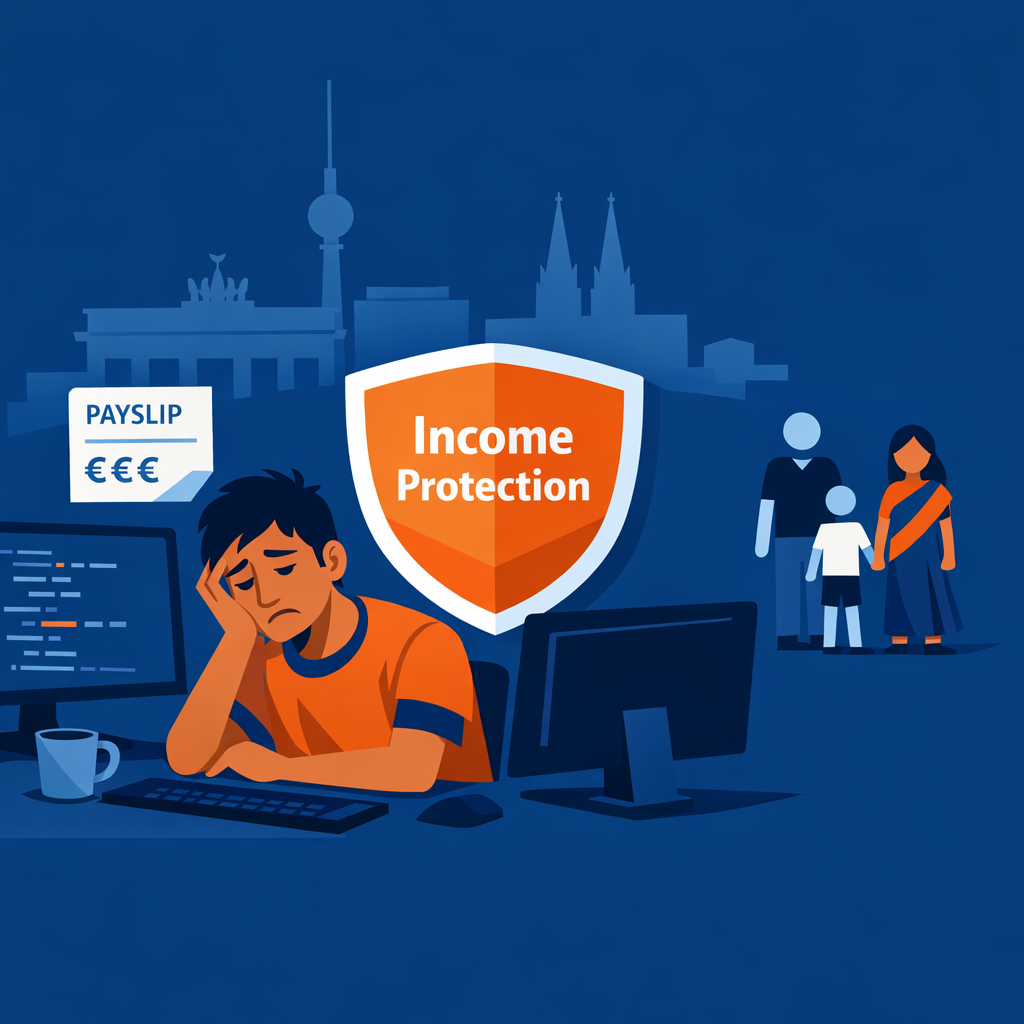
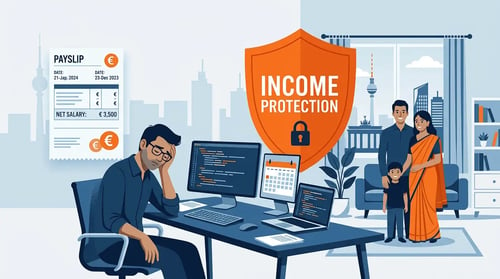
Imagine this: It is 11:30 pm on a Wednesday in Berlin. Your sprint demo is tomorrow, the client wants “just one more feature” and your team in India is already offline. You are still online, trying to fix a production bug while your phone keeps buzzing with Slack messages.
You tell yourself it is “just this release” and after that it will be calm again. But then the next project starts. You sleep badly, you feel exhausted in the morning, you cannot focus. One day you sit in front of your laptop and your body simply says “no”.
The doctor in Germany does not just say “take a weekend off”. Instead, they sign you off work for several weeks with stress, burnout or depression. Suddenly you are at home, not in the office, and your entire life depends on how long your salary continues and what the system really pays when you cannot work.
This is not a rare, extreme case. For many office workers and IT professionals, mental health issues and chronic back problems are among the most common reasons for long-term absence from work. That is exactly why income protection is not a “nice extra” – it is a core part of your Germany strategy.
Why health insurance alone is not enough
In almost every Indian IT WhatsApp group in Germany you hear similar stories: a consultant who has been on sick leave for half a year, a product owner who completely burned out, a developer who can no longer sit in front of a laptop because of chronic back pain.
The combination of:
- high performance expectations,
- international teams and time zones,
- constant deadlines and client pressure,
- and the emotional stress of building a life in a foreign country
means that mental health issues and musculoskeletal problems are now very common reasons why people cannot work for a longer period of time.
In India, family and social networks can often help when something goes wrong. In Germany, you might sit alone in a flat in Munich, Frankfurt or Berlin with:
- high rent and deposits,
- monthly costs for food, transport, childcare and insurances,
- and financial responsibilities in India such as EMIs, support for parents, or education for siblings.
Health insurance in Germany is strong – but it is mainly there to pay your medical bills, not to fully replace your salary. That is where many Indian professionals underestimate the risk.
Myths Indian IT professionals often believe – and the reality
In Indian expat circles in Germany there are some very common beliefs about the German system. Some of them are only half true. Others are simply wrong. Here are a few typical examples:
- Myth 1: “Germany has such a strong social system, the state will pay my full salary if I am sick.”
Reality: The system pays support, but it is not designed to replace a full IT salary. Sick pay and pensions are limited and often leave a big gap compared to your usual net income. - Myth 2: “Burnout is just stress; if it gets bad, I will take two weeks off and then continue as normal.”
Reality: Many burnout or depression cases lead to months of sick leave. In serious cases, people cannot return to their previous role at all. - Myth 3: “If something happens, I can always move back to India.”
Reality: Moving countries in the middle of a health crisis is hard. You might still have contracts, long-term commitments and maybe a partner or children in Germany. - Myth 4: “I am still young, I will deal with this later.”
Reality: Income protection is usually cheaper and easier to get when you are young and healthy. Waiting until the first diagnosis often means higher premiums or exclusions.
What Germany pays if you get sick – and where the gap starts
To understand how to protect your income, it helps to know what Germany already does for you by default. Here is a simplified overview for employees in Germany:
- First 6 weeks: Your employer normally continues to pay your full salary if you are unable to work due to illness. This is called continued salary payment.
- From week 7: Your statutory health insurance pays sickness benefit (Krankengeld). This is about 70% of your gross salary, but it cannot exceed 90% of your net salary and it is capped at a legal maximum per day.
- Long-term inability to work: If your ability to work is permanently reduced, you may be entitled to a reduced earning capacity pension from the German pension system. For many professionals, this pension is significantly lower than their usual salary.
This structure creates a clear pattern: short-term illness is relatively well protected, but long-term health issues create a serious income gap – especially for high earners in IT.
Realistic example: how big can your income gap be?
Let us look at a simplified example. The exact numbers will vary, but this gives you a feeling for the dimensions.
Imagine you are:
- 31 years old
- software engineer in Munich
- gross salary: 4,500 € per month
- net salary: around 2,800 € per month (after tax and social security)
Your typical monthly costs might look like this:
- rent and utilities: 1,400 €
- food and daily expenses: 500 €
- transport, phone, internet: 200 €
- insurances and subscriptions: 150 €
- money sent to India (EMIs, parents, siblings): 400 €
Total: about 2,650 € every month.
Now imagine you are off sick for a longer time:
- During the first 6 weeks, your employer continues to pay your full salary, so nothing changes.
- After 6 weeks, your health insurance pays sickness benefit of roughly 70% of your gross salary. In this example, that might be around 2,300–2,400 € per month, depending on caps and details.
Suddenly your monthly income might be 400–500 € below your normal net salary. If your fixed costs are already close to your net income, there is no real buffer.
And that is only the mid-term scenario. If you can no longer work in your current job at all and you end up on a reduced earning capacity pension, the gap can easily become much larger.
This is exactly the situation where a well-designed private income protection plan makes the difference between “we can manage this” and “we have to completely change our life”.
How private income protection works in Germany
Private income protection in Germany is usually called occupational disability insurance or “Berufsunfähigkeitsversicherung”. The basic idea is simple:
- If illness or an accident prevents you from doing your current occupation by at least around 50% for a longer period, the insurer pays you a monthly pension.
- This pension is paid on top of any statutory benefits, so it fills the income gap between what the state pays and what you actually need.
Some key features you can usually adjust:
- Monthly benefit amount: How much you want to receive every month if you become unable to work in your occupation. Many people aim to cover the majority of their essential costs, often 50–70% of their net income.
- End age: Until what age the
Mar 18, 2026 1:24:08 PM
Comments